
A closer look · Strategy
Mini Motorways
Choose Mini Motorways for road-network planning where every junction and limited upgrade affects a growing city.
Game facts
- Developer
- Dinosaur Polo Club
- Publisher
- Dinosaur Polo Club
- Released
- 20 July 2021
- Platforms
- Windows · macOS (Steam edition)
- Model
- Paid game
- PEGI
- 3 — Nintendo Switch edition; not a separate PC classification
- Players
- Single-player
- Length
- Short
- Difficulty
- 3 / 5 · Moderate
- Steam Deck
- Verified
PEGI source ↗ · Steam Deck status source ↗
Edition: Base game
The score, explained
The interest and responsiveness of the core decisions and actions.
How progression, exploration and goals fit together.
The coherence of the visual, musical and narrative presentation.
How clearly the game explains its rules and offers useful ways to engage.
The depth of optional goals, alternative approaches and reasons to return.
Draw a road, change the whole network
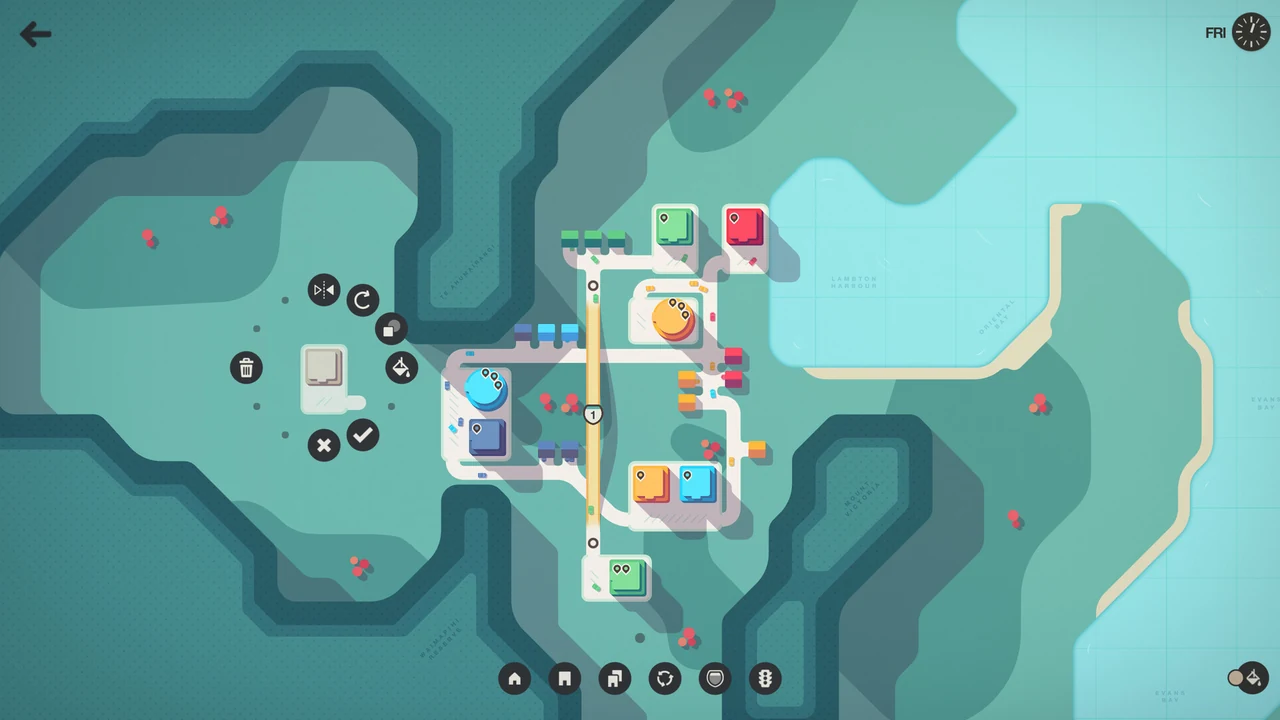
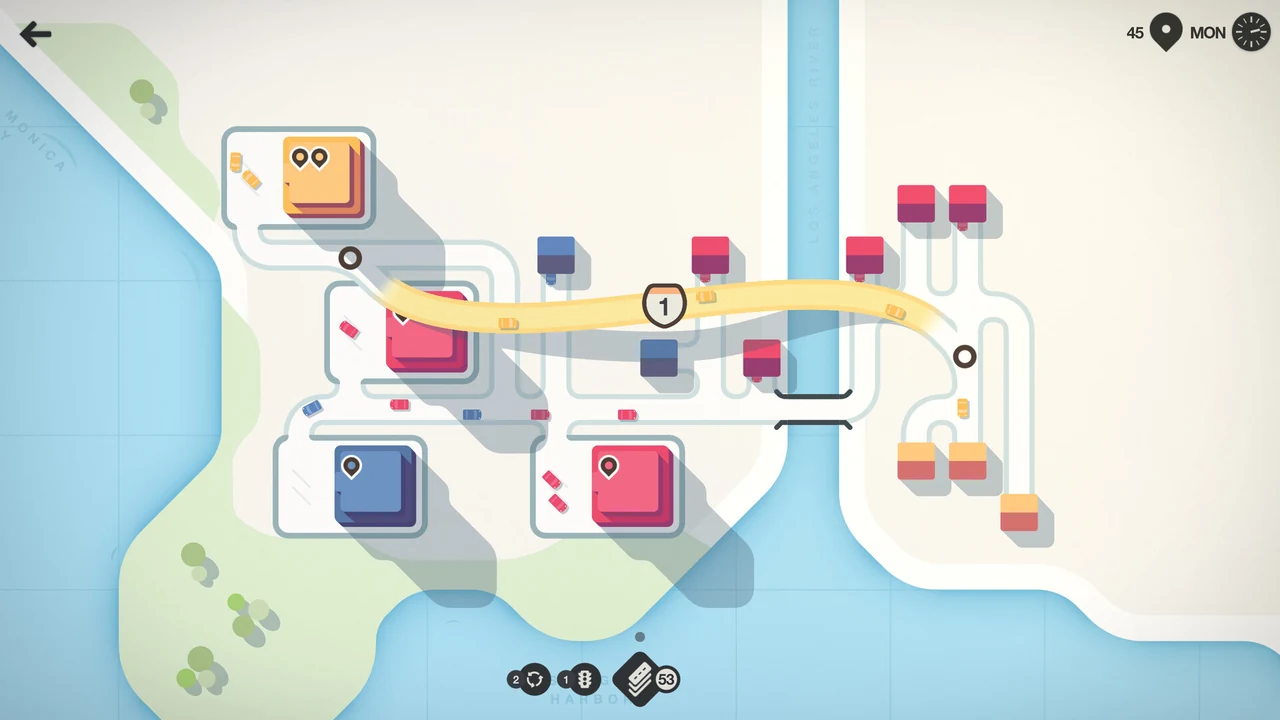
Mini Motorways turns road drawing into a problem of meeting changing demand. New parts of the city need connections, while the routes already in place can create congestion when more traffic uses them. The game pairs this evolving map with upgrades such as motorways and roundabouts. The strongest element is the difference between connecting somewhere and serving it well. A direct road is not automatically the best long-term answer if it funnels too much movement through the same point. This is a focused network puzzle rather than a full city administration simulation. Players who enjoy reconsidering the structure of a plan have a clearer fit than those who mainly want to decorate a permanent urban scene.
Choose pressure or room to experiment
The growing city supplies an ongoing reason to revise the road network, but the current official feature list offers several ways to experience that pressure. Endless Mode supports continued building, Creative Mode provides broader editing freedom, and Expert Mode changes the constraints through features such as permanent roads. Daily and weekly challenges add another form of repeatable task. We rate the structure highly because the modes serve different planning preferences without abandoning the central road-building idea. A player should choose deliberately between experimenting and surviving. The same layout priorities will not necessarily work across all modes, and a quiet-looking map can still demand close attention when the selected rules make growth increasingly difficult to manage.
A readable city in miniature
The visual style reduces the city to the buildings, roads and movement needed for the problem at hand. That makes the road network a clear subject for observation rather than hiding it beneath realistic detail. We rate the presentation for this agreement between appearance and interaction. The game also confirms alternative colour palettes, including colourblind and night options, as well as a soundtrack that changes with the city. Those features provide useful starting points when checking suitability, but are not a substitute for an individual's needs. The key aesthetic preference is whether a clean, diagram-like city is more appealing than a dense simulation with many additional visual layers. A newly appearing destination can make yesterday's neat road network awkward almost immediately.
For planners who like revising their work
Mini Motorways is a strong choice when a network failure prompts curiosity about what could be changed next time. Different maps, growth patterns and modes give those revisions a available context, supporting a high reasons-to-return score. It is less suitable if rebuilding feels like losing work rather than learning something. Mini Metro offers a closely related alternative with a more abstract rail-map vocabulary and different connection problems. Choose Mini Motorways when junctions, routes and bottlenecks are the interesting part of planning. Its appeal lies in seeing how a small road decision can affect movement across the city, then deciding whether the next improvement should be an extra connection or the removal of an unhelpful one. This archive review remains useful when comparing Mini Motorways's strategy structure with the current selection. Road placement produces clear strategic trade-offs.
The verdict
Choose Mini Motorways for road-network planning where every junction and limited upgrade affects a growing city.
Reasons to play
- Road placement produces clear strategic trade-offs
- Limited upgrades give planning decisions weight
- City layouts and challenges support repeat play
Reasons to think twice
- No fixed main-story completion target
- A road layout can become difficult to rescue
- The focus is traffic management, not a detailed city simulator
See the game
Assist & accessibility
Explore the available settings and control options on the official game page before choosing your setup.
Parents’ guide
Players: Single-player. No in-game purchase marker in the checked Steam listing. Separate downloadable content may be sold.
Age classification: 3. Nintendo Switch edition; not a separate PC classification
A useful starting tip
Look at where traffic converges before extending a road; a convenient connection now can create a bottleneck as the city grows.
A different direction
Compare this with Mini Metro: Choose Mini Metro for a focused transport-planning puzzle built around connecting stations as a city grows.
Official sources
Reviewed: November 2026
You might also like
 DorfromantikRead review →
 Chicory: A Colorful TaleRead review →
 Mini MetroRead review →