
A closer look · Strategy
Mini Metro
Choose Mini Metro for a focused transport-planning puzzle built around connecting stations as a city grows.
Game facts
- Developer
- Dinosaur Polo Club
- Publisher
- Dinosaur Polo Club
- Released
- 6 November 2015
- Platforms
- Windows · macOS · Linux (Steam edition)
- Model
- Paid game
- PEGI
- 3 — Nintendo Switch edition; not a separate PC classification
- Players
- Single-player
- Length
- Short
- Difficulty
- 3 / 5 · Moderate
- Steam Deck
- Verified
PEGI source ↗ · Steam Deck status source ↗
Edition: Base game
The score, explained
The interest and responsiveness of the core decisions and actions.
How progression, exploration and goals fit together.
The coherence of the visual, musical and narrative presentation.
How clearly the game explains its rules and offers useful ways to engage.
The depth of optional goals, alternative approaches and reasons to return.
A line on the map becomes a service
Mini Metro asks the player to connect stations in a growing city and keep passengers moving between them. Drawing a line is simple, but each connection changes the demands placed on the rest of the network. The game makes overcrowding the central pressure, with new stations and passengers forcing revisions to an initially workable plan. The strongest element is that clear relationship between action and consequence. It is a constructive puzzle rather than a detailed railway management simulation. Readers who want train schedules, company finances or realistic engineering should not expect those systems to be the attraction. The main task is reading an abstract network and deciding how a limited set of resources can serve it better.
Growth keeps the plan provisional
The map changes as the city expands, so a successful opening layout is not a permanent solution. New assets offer opportunities, while different city maps introduce their own obstacles and rhythms. The game includes Normal, Endless, Extreme and Creative modes, providing distinct ways to approach the network problem. We rate the structure highly because it recognises that some players want pressure and others want space to experiment. That does not mean every mode teaches the same priorities. A layout built for expression can differ from one built to survive growth. The useful decision is which kind of planning session you want, then treating the chosen mode's constraints as the point of the exercise.
The map is also the interface
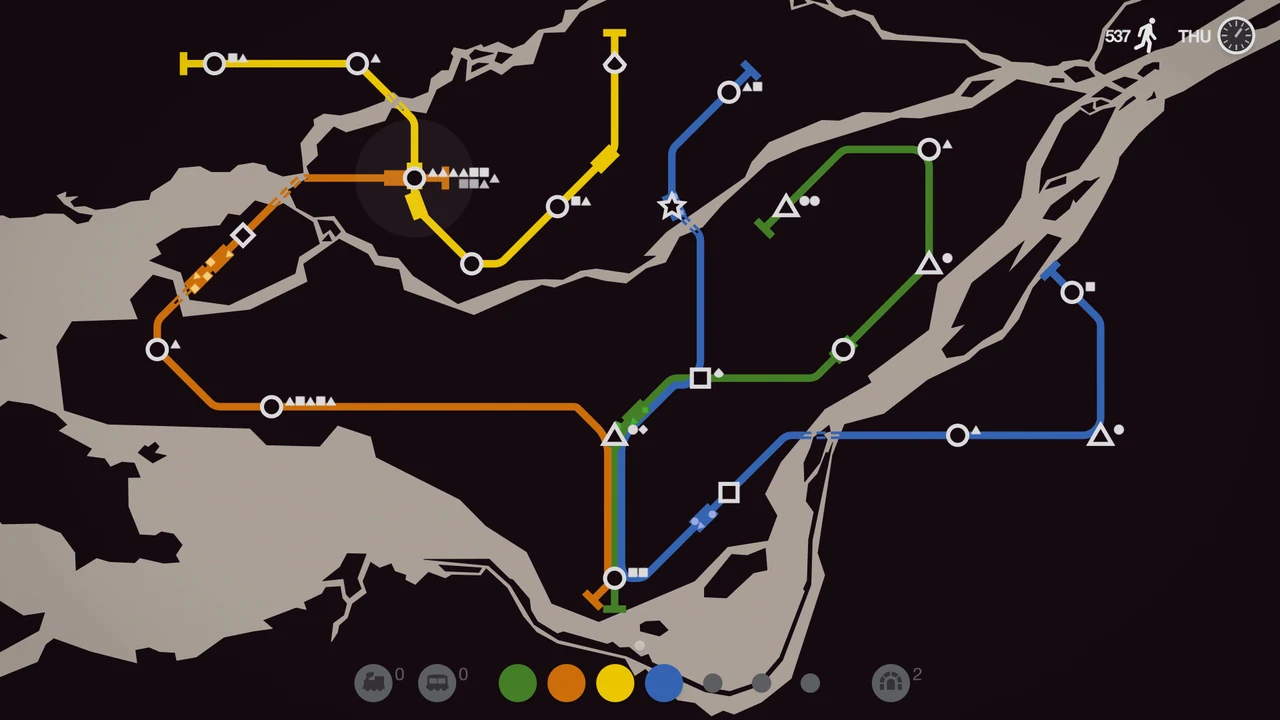
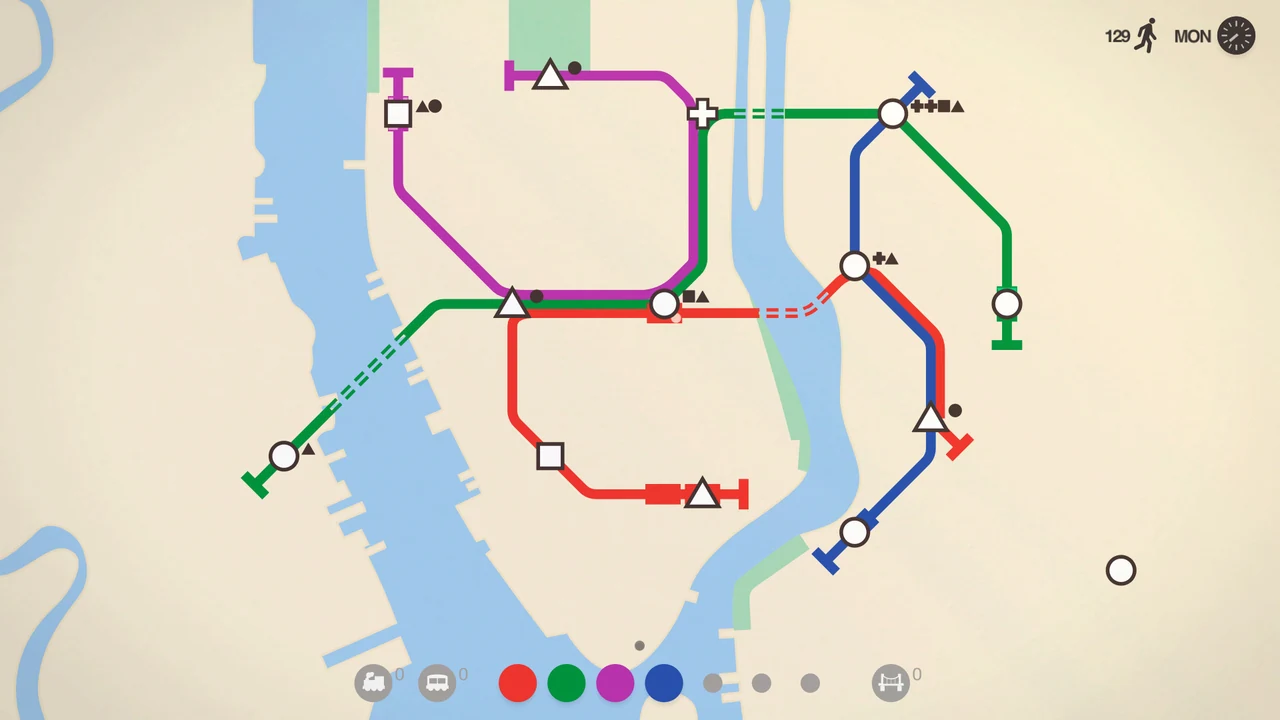
Mini Metro's abstract transit-map style makes the network itself the central image. Stations, lines and moving trains carry information rather than merely decorating a separate control panel. We value that economy of presentation because it helps make a planning problem visible. The game also identifies colourblind and night modes, along with a responsive soundtrack that follows the developing network. These settings offer practical ways to distinguish routes while keeping the network's compact visual language intact. Our presentation score concerns the fit between the game and its clear graphical language. Players who prefer highly detailed city scenery may find it sparse, while readers who enjoy diagrams are likely to see that sparseness as a strength.
Return to test a different connection
Mini Metro gives repeat play a concrete foundation through changing growth patterns, city layouts and modes. A failed network can suggest a specific lesson about transfers, overloaded sections or the use of limited assets, making another attempt more than simply drawing the same lines again. Our return score reflects that design without implying that procedural growth guarantees endless novelty. Mini Motorways offers a related challenge if road junctions and traffic are more interesting than railway lines. Choose Mini Metro for the clarity of an abstract network where every connection has a visible consequence. Its strongest appeal is the moment when a complicated service problem can be improved by a comparatively small change to the map. In our quiet problems selection, Mini Metro earns its place because minimal maps make network problems visible.
The verdict
Choose Mini Metro for a focused transport-planning puzzle built around connecting stations as a city grows.
Reasons to play
- Minimal maps make network problems visible
- Limited resources create clear planning trade-offs
- Different city layouts support repeat attempts
Reasons to think twice
- There is no conventional story campaign
- The abstract presentation may feel sparse
- Increasing congestion can make a quiet start more demanding
See the game
Assist & accessibility
Explore the available settings and control options on the official game page before choosing your setup.
Parents’ guide
Players: Single-player. No in-game purchase marker in the checked Steam listing. Separate downloadable content may be sold.
Age classification: 3. Nintendo Switch edition; not a separate PC classification
A useful starting tip
Investigate the cause of a crowded station before adding another long line; an awkward transfer can be more important than raw capacity.
A different direction
Compare this with Mini Motorways: Choose Mini Motorways for road-network planning where every junction and limited upgrade affects a growing city.
Official sources
Reviewed: November 2026
You might also like
 DorfromantikRead review →
 Chicory: A Colorful TaleRead review →
 TOEM: A Photo AdventureRead review →