
A closer look · Management adventure
Spiritfarer: Farewell Edition
A gentle management routine wrapped around difficult goodbyes and memorable passengers.
Game facts
- Developer
- Thunder Lotus
- Publisher
- Thunder Lotus
- Released
- 18 August 2020
- Platforms
- Windows · macOS · Linux (Steam edition)
- Model
- Paid game
- PEGI
- 12 · Mild Swearing, Sexual Innuendo — Steam UK listing
- Players
- Single-player · Multi-player · Co-op · Shared/Split Screen Co-op
- Length
- Long
- Difficulty
- 2 / 5 · Approachable
- Steam Deck
- Verified
PEGI source ↗ · Steam Deck status source ↗
Edition: Base game
The score, explained
The interest and responsiveness of the core decisions and actions.
How progression, exploration and goals fit together.
The coherence of the visual, musical and narrative presentation.
How clearly the game explains its rules and offers useful ways to engage.
The depth of optional goals, alternative approaches and reasons to return.
Care expressed through daily tasks
Spiritfarer turns management into a way of looking after people. As Stella, you improve a ferry, gather materials, prepare food and welcome spirit passengers before helping them move on. The resource loop therefore has a narrative purpose beyond expanding production for its own sake. Fishing, farming, crafting and cooking contribute to a place where the characters can spend time together. Our assessment values the connection between those practical actions and the subject of farewell. The same design brings repetition: someone who dislikes collecting ingredients and returning to familiar jobs may not find the story enough to sustain every routine. The game makes the relationship between care, work and loss explicit, so that emotional context should shape the decision to play.
A ferry that records your progress
The boat is both a home and a visible record of what you have achieved. Improving it supports further travel, while the wider world offers materials, gifts and opportunities to develop relationships with the passengers. Platforming also gives the adventure a physical dimension beyond menus and production tasks. The Farewell Edition is the edition currently listed on Steam, bringing the base game together with its additional content updates. That matters when comparing this entry with an older description of the original release. We see the expanding ferry as the structure's strongest organising idea: several systems feed into the same shared space. Readers who prefer one puzzle after another, with little housekeeping between them, should consider a more concentrated adventure instead.
Warm artwork, difficult subject matter
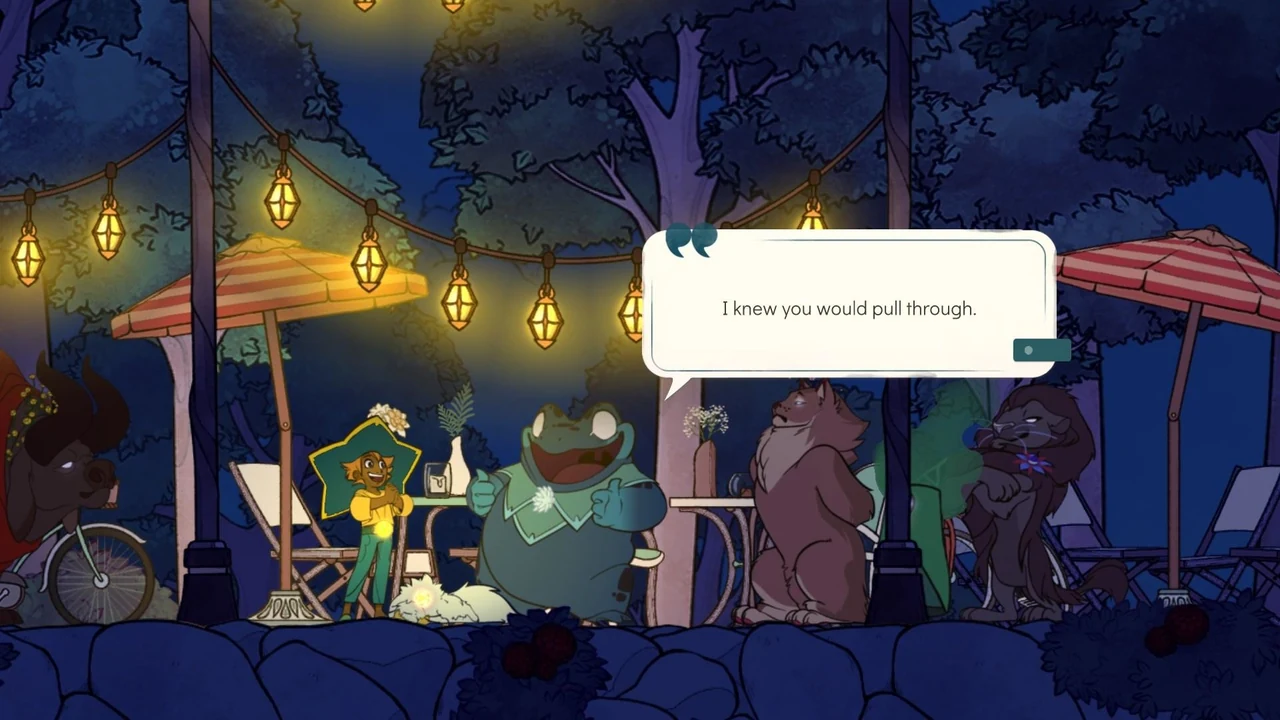
Hand-drawn animation and expressive character designs give Spiritfarer a welcoming surface, but the central subject remains death. Its warmth should not be read as a promise that the story will always be easy company. Caring for passengers before saying goodbye is the point of the journey, and the ferry's domestic activities make those departures more personal in concept. The game also confirms an optional second-player role as Daffodil the cat, offering a way to share the tasks through local co-operative play. We rate the presentation for how consistently it supports companionship and change. Growing crops, preparing meals and improving cabins turn the boat into a place of care. Departures at the Everdoor then change the meaning of those routines, making its gentle management systems inseparable from its themes of loss and companionship.
Best when routine is part of the pleasure
Spiritfarer is an appealing choice when you want a game to create a familiar rhythm and then attach that rhythm to particular characters. It is less convincing as a recommendation for someone who wants frequent combat, tightly timed challenges or a succession of entirely new mechanical ideas. Our return score is deliberately more restrained than the presentation score: the desire to revisit these relationships is personal, whereas the structure is primarily an authored journey with management alongside it. The catalogue comparison with Chicory is useful here. Both place expressive characters near the centre, but Chicory turns more of its moment-to-moment play into environmental puzzle solving. Choose Spiritfarer when maintaining a shared home sounds like meaningful play in its own right. In our personal stories selection, Spiritfarer: Farewell Edition earns its place because boat improvement gives daily tasks a shared purpose.
The verdict
A gentle management routine wrapped around difficult goodbyes and memorable passengers.
Reasons to play
- Boat improvement gives daily tasks a shared purpose
- Passenger relationships connect management to the story
- Optional local co-op offers a shared way to play
Reasons to think twice
- Gathering and crafting involve repeated routines
- Themes of death and farewell may feel emotionally demanding
See the game

Assist & accessibility
Explore the available settings and control options on the official game page before choosing your setup.
Parents’ guide
Players: Single-player · Multi-player · Co-op · Shared/Split Screen Co-op. No in-game purchase marker in the checked Steam listing. Separate downloadable content may be sold.
Age classification: 12. Mild Swearing · Sexual Innuendo Steam UK listing
A useful starting tip
Group several passengers' needs before a journey so that gathering has a clear purpose beyond filling storage.
A different direction
Compare this with Chicory: A Colorful Tale: A creative adventure where colouring changes both the landscape and your relationship with it.
Official sources
Reviewed: November 2026
You might also like
 DorfromantikRead review →
 Chicory: A Colorful TaleRead review →
 Mini MetroRead review →