A closer look · Creative
Townscaper
Choose Townscaper for free-form town building without a campaign, competitive target or resource-management economy. Choose it when arranging buildings is enough, without needing quests or a management economy to supply a goal.
Game facts
- Developer
- Oskar Stålberg
- Publisher
- Raw Fury
- Released
- 26 August 2021
- Platforms
- Windows · macOS (Steam edition)
- Model
- Paid game
- PEGI
- 3 — Nintendo Switch edition; not a separate PC classification
- Players
- Single-player
- Length
- Short
- Difficulty
- 1 / 5 · Gentle
- Steam Deck
- Verified
PEGI source ↗ · Steam Deck status source ↗
Edition: Base game
The score, explained
The interest and responsiveness of the core decisions and actions.
How progression, exploration and goals fit together.
The coherence of the visual, musical and narrative presentation.
How clearly the game explains its rules and offers useful ways to engage.
The depth of optional goals, alternative approaches and reasons to return.
Building is the activity
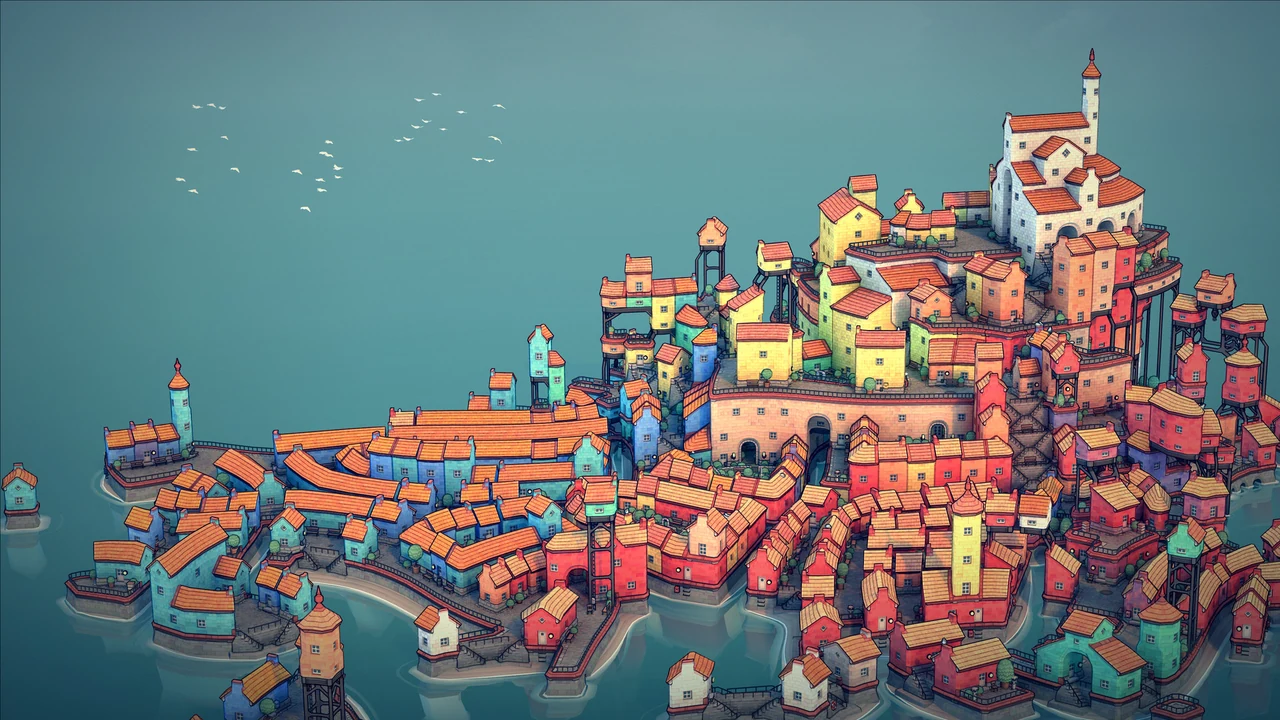
Townscaper removes the usual city-building questions about money, population needs and infrastructure capacity. The game presents it as a construction toy: place coloured blocks on an irregular grid and watch the system turn their relationships into houses, arches, stairs and other forms. The strongest element is that immediate connection between a small action and a visible result. The important limitation is equally explicit. There is no conventional campaign goal waiting behind the pleasant townscape. Readers who enjoy experimenting with shapes have a clear reason to engage, while someone who needs resource pressure or a victory condition may find the same freedom empty. Townscaper is best judged by whether making the place is enough.
Progress means changing your own idea
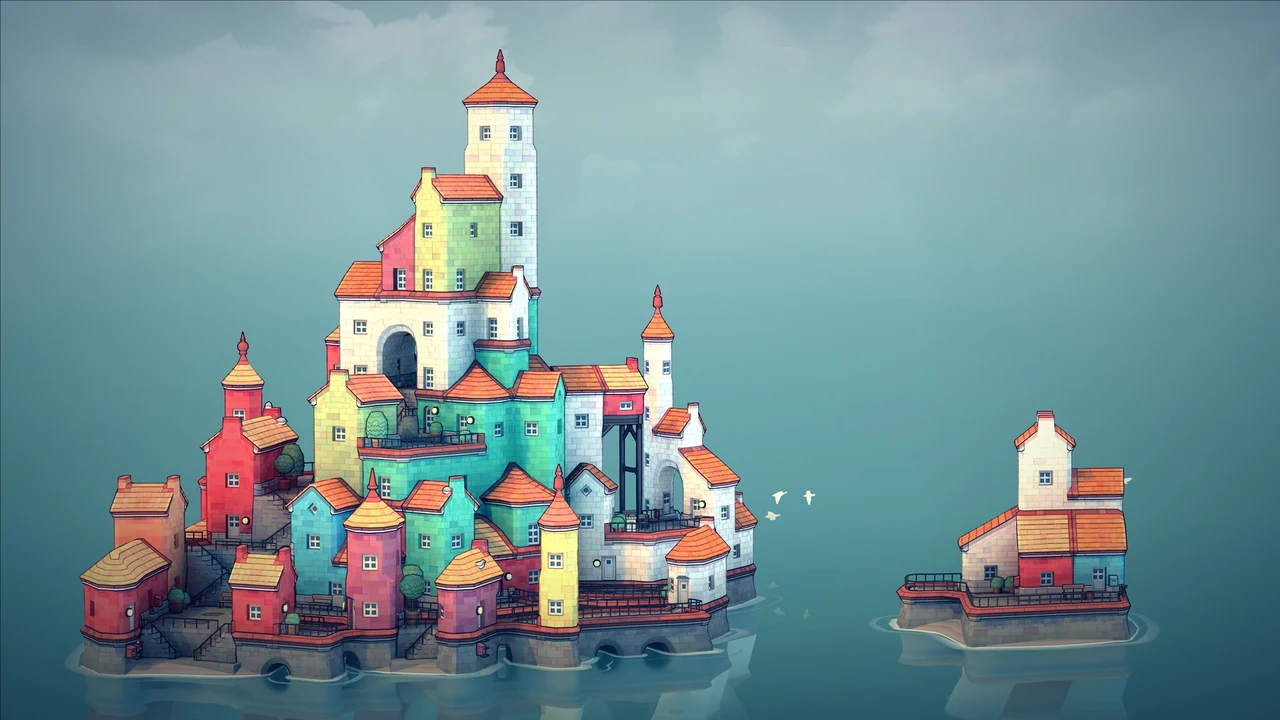
Without a mission ladder, the structure comes from the builder's decisions. A few blocks can become a courtyard, a tower or a waterside cluster, and an experiment can be revised rather than defended as a permanent commitment. The interesting progression is understanding how arrangements affect the generated architecture. We rate this structure according to its success as an open creative tool, not by pretending it contains a traditional campaign. That difference matters when choosing between catalogue entries. If a game needs to tell you what to do next, Townscaper offers relatively little external direction. If a promising shape naturally suggests another alteration, the absence of assigned work becomes a useful part of the experience.
Architecture as immediate feedback
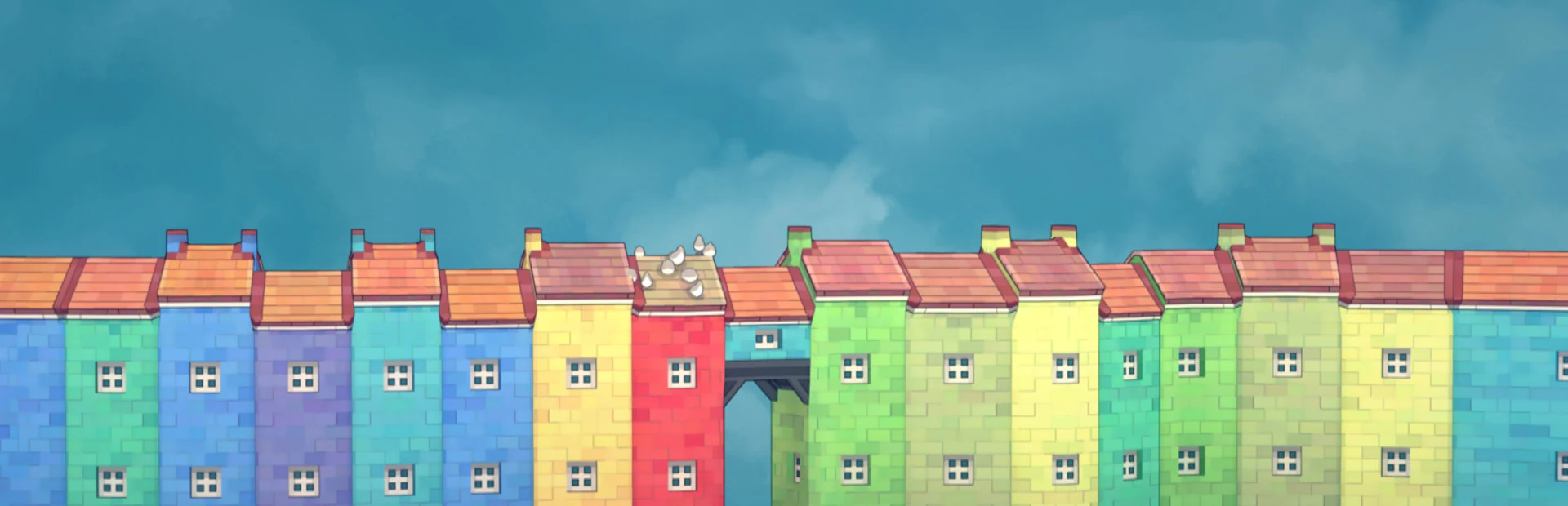
The recognisable colours and compact buildings give Townscaper an unusually direct visual response to construction. The official mechanism links neighbouring blocks to automatically generated architectural details, so a change can produce more than the simple shape you placed. We value this relationship between presentation and interaction: the town is both the result and the feedback that encourages another experiment. The aesthetic remains deliberately specialised. Readers seeking realistic engineering, detailed interiors or a full simulation of urban life should not infer those systems from the attractive buildings. A row of blocks can become a street or an elevated structure, and changing its neighbours can produce a surprisingly different silhouette. The appeal is in discovering those architectural responses through direct experimentation.
A return driven by a new idea
Townscaper has no meaningful universal finishing time because the activity is self-directed construction. Returning makes sense when you want to try another arrangement, colour relationship or building shape. That supports replay for a particular audience without implying an endless supply of authored challenges. A Little to the Left is a helpful contrast for a reader who enjoys arranging objects but wants a puzzle to recognise when the work is done. Choose Townscaper when the ability to revise and expand an idea is the reward itself. Its limited management depth is not hidden, and should be treated as a reason either to select it or to choose a more structured game, depending on the kind of play you want. Choose it when arranging buildings is enough, without needing quests or a management economy to supply a goal.
The verdict
Choose Townscaper for free-form town building without a campaign, competitive target or resource-management economy. Choose it when arranging buildings is enough, without needing quests or a management economy to supply a goal.
Reasons to play
- Immediate focus on arranging and shaping buildings
- No resource economy to manage
- Distinctive, coherent town imagery
Reasons to think twice
- No story campaign or defined completion target
- Limited management depth
- Players seeking missions may find the structure too open
See the game
Assist & accessibility
Explore the available settings and control options on the official game page before choosing your setup.
Parents’ guide
Players: Single-player. No in-game purchase marker in the checked Steam listing. Separate downloadable content may be sold.
Age classification: 3. Nintendo Switch edition; not a separate PC classification
A useful starting tip
Change the height and position of a small cluster before expanding; the interesting discovery is often how nearby blocks transform together.
A different direction
Compare this with Tiny Glade: Choose Tiny Glade for free-form building and detailed miniature scenes without combat or management pressure. This is our creative-building pick because it removes resource pressure while keeping the act of construction expressive.
Official sources
Reviewed: November 2026
You might also like
 DorfromantikRead review →
 Chicory: A Colorful TaleRead review →
 Mini MetroRead review →